

Tempered Glass Screen Protector: Myth vs. Reality in 2026
2026 Jun 13th
Your smartphone's "unbreakable" screen isn't actually invincible. Even with the latest Ceramic Shield or Gorilla Glass Victus 2, a quality tempered glass screen protector remains your device's most critical insurance policy in 2026. You've likely felt the frustration of confusing marketing terms like "9H hardness" and wondered if it's all just hype. It's perfectly normal to worry about losing touch sensitivity or dealing with bubbles that ruin a premium aesthetic.
We're here to cut through the technical noise. You'll discover the real difference between the Mohs scale and pencil hardness ratings. This article explains why tempered glass is still the gold standard for Canadian device protection, acting as a sacrificial layer to manage kinetic energy that modern screens can't handle alone. We'll examine the latest 0.15mm ultra-thin formulations and show you how to maintain maximum resale value. It's time to separate marketing myths from the functional reality of keeping your hardware pristine.
Key Takeaways
- Understand why modern "unbreakable" screens prioritize shatter-resistance over scratch-resistance, leaving devices vulnerable to everyday abrasions.
- Learn the material science behind a tempered glass screen protector, specifically the difference between 9H pencil hardness and the Mohs scale.
- Evaluate the functional benefits of aluminosilicate glass versus alternative solutions like TPU films or liquid coatings.
- Realize how precision-cut, ultra-thin glass maintains native touch sensitivity and ensures compatibility with ultrasonic fingerprint sensors.
- Identify high-performance, case-friendly designs that prevent edge-lifting to secure your hardware investment and maintain resale value.
The Unbreakable Screen Myth: Why 2026 Devices Still Need Protection
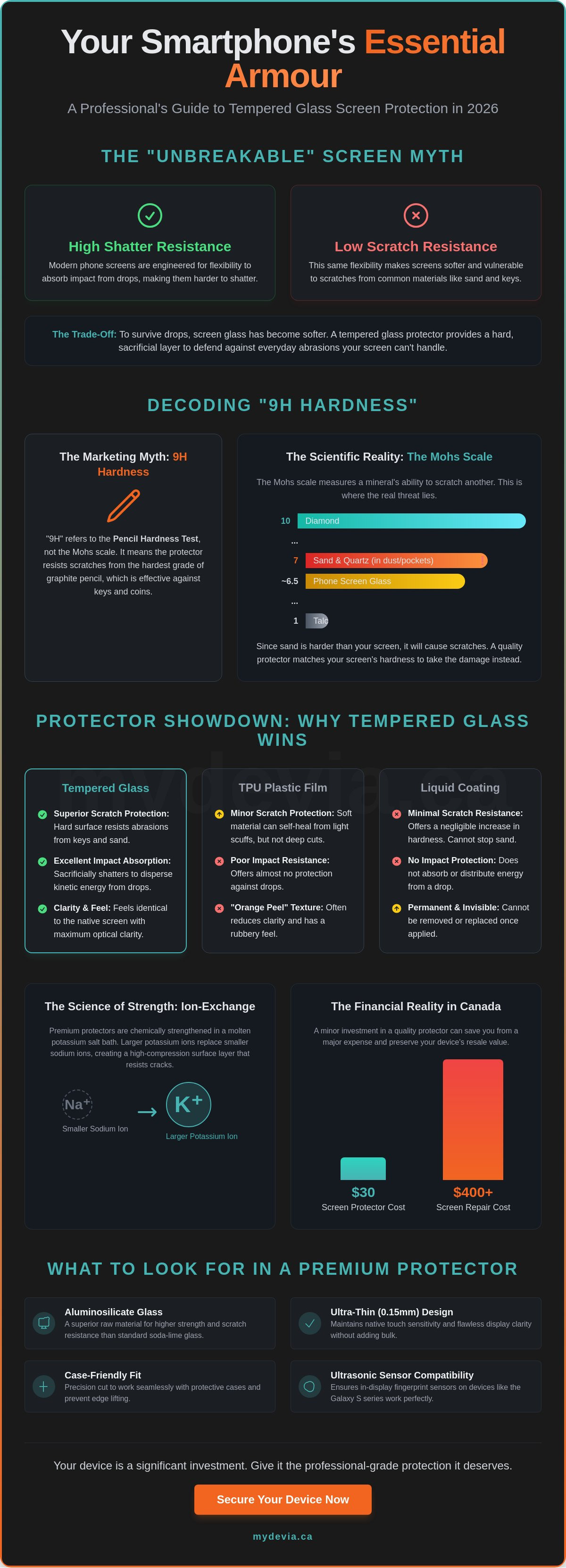
Modern flagship devices like the iPhone 17 and Samsung Galaxy S series feature the most advanced glass ever produced. Marketing campaigns often label these displays as "unbreakable," highlighting their ability to survive significant drops. However, there is a fundamental trade-off in material science that these ads rarely mention. While screens have become much harder to shatter, they have simultaneously become easier to scratch. This paradox is the primary reason why a high-quality tempered glass screen protector remains an essential investment for Canadian consumers.
The engineering behind tempered or toughened glass involves controlled thermal or chemical treatments to increase its strength. In the context of a smartphone, the factory display is optimized for flexibility to absorb impact energy. This softer molecular structure prevents the glass from spiderwebbing during a fall, but it allows everyday materials like sand, keys, and pocket debris to leave permanent marks. A tempered glass screen protector acts as a sacrificial barrier, absorbing kinetic energy and surface friction before it reaches the expensive OLED or LCD panel beneath.
Hardness vs. Flexibility in Modern Displays
The relationship between hardness and brittleness is a constant challenge for hardware manufacturers. Harder materials resist scratches but are prone to cracking under pressure. To achieve the 6-foot drop ratings seen in 2026, manufacturers use aluminosilicate glass that is slightly more "elastic." This elasticity is great for drop survival, but it fails against common environmental hazards:
- Quartz and Sand: These materials rank 7 on the Mohs scale, which is harder than most factory glass.
- Micro-abrasions: Tiny surface scratches act as stress concentrators, weakening the screen's structural integrity over time.
- Sacrificial Failure: It is more efficient to replace a $30 protector than a $400 display assembly.
The Financial Reality of Screen Repairs in Canada
Repair costs for premium devices in Canada continue to climb as display technology becomes more integrated. Replacing a damaged screen often requires swapping the entire front housing, sensors, and digitizer. Maintaining a "mint" condition device is the most effective way to secure a high trade-in value or resale price. Professional buyers often deduct hundreds of dollars for even minor surface scratches that are visible under direct light.
Pairing your device with a high-performance iPhone 17 case and a screen protector creates a 360-degree safety net. This combination ensures that the hardware remains in factory condition, protecting your investment for the long term. A scratch-free screen isn't just about aesthetics; it's about preserving the functional and financial value of your tech.
Decoding 9H Hardness: Material Science and the Mohs Scale
Most marketing for a tempered glass screen protector relies heavily on the "9H" label. Consumers often mistake this for the Mohs scale of mineral hardness, where 9 represents sapphire or corundum. In reality, 9H refers to the Wolff-Wilborn pencil hardness test. This standardized procedure determines a material's resistance to scratches from the hardest grade of graphite pencil. While a 9H rating confirms excellent protection against common household items, it doesn't mean the glass is invincible against all minerals.
Premium protectors utilize aluminosilicate glass, which incorporates aluminum oxide into the silicate base. This material is significantly more robust than the standard soda-lime glass found in budget-tier options. The specific mechanical properties of glass used in these protectors determine how the surface reacts to localized stress and impact. By using higher-quality raw materials, manufacturers can produce thinner sheets that maintain high structural integrity without sacrificing clarity.
The Ion-Exchange Process Explained
Chemical tempering involves a submerged bath of molten potassium salts at high temperatures. During this stage, larger potassium ions migrate into the glass to replace smaller sodium ions. This ionic swap creates a dense compression layer on the surface that effectively pulls the glass together. This tension prevents crack propagation from microscopic surface flaws. Chemical tempering serves as the fundamental core of modern glass durability.
Testing for Real-World Scratches
Metal objects like keys, coins, and stainless steel tools typically rank between 5 and 5.5 on the Mohs scale. Since a high-quality tempered glass screen protector usually sits at a 6 or 7, these metal items won't leave a permanent mark. However, environmental hazards like beach sand often contain quartz, which ranks at 7 on the Mohs scale. This explains why a device can survive a pocket full of change but suffer damage at the lake. To maintain a smooth user experience, premium glass also includes a vacuum-deposited oleophobic coating. This layer repels skin oils and reduces fingerprint smudges, ensuring the display remains clear and responsive.
For those seeking lab-tested durability, choosing from a collection of premium screen protectors ensures your device meets these rigorous technical standards.
Tempered Glass vs. Alternatives: A Comparative Analysis
Choosing the right display protection involves navigating a crowded market of films, liquids, and glass. While a tempered glass screen protector provides the highest level of impact resistance, other materials serve specific niche purposes. Understanding these differences ensures you don't compromise your device's safety for a cheaper or more convenient-sounding alternative. Each material reacts differently to stress, and the wrong choice can leave your hardware vulnerable to expensive repairs.
Thermoplastic Polyurethane (TPU) films are the primary alternative to glass. These plastic-based layers are thin and flexible. They are often marketed for their "self-healing" properties, where minor surface dents disappear over time as the material settles. However, TPU offers minimal protection against heavy impacts. Unlike glass, which shatters to absorb energy, TPU allows the force to pass directly into the device's display. This often results in a pristine-looking film over a shattered OLED panel.
Liquid screen protectors are a common source of consumer confusion. These silicon-dioxide (SiO2) coatings claim to "harden" your screen at a molecular level. In reality, they are merely ultra-thin chemical layers that improve surface smoothness. They provide zero structural reinforcement and cannot be removed once applied. For genuine security, a physical barrier is always superior to a chemical wipe. If you want to protect your investment, stick to physical layers that can be replaced if they take a hit.
Performance Metrics: Glass vs. Film
Optical clarity remains the strongest argument for glass. High-grade aluminosilicate glass offers over 99% light transmission, maintaining the vivid colours and sharpness of your 2026 display. TPU films often introduce a "rainbow effect" or a slight orange-peel texture that distorts the image. In terms of impact, the sacrificial nature of glass is its greatest asset. It breaks so your phone doesn't. TPU is better suited for scratch prevention on curved surfaces where rigid glass might struggle to adhere without precision engineering.
- Clarity: Glass provides a native display feel and superior transparency.
- Impact: Glass manages kinetic energy through sacrificial failure.
- Maintenance: TPU requires less frequent replacement but offers lower protection levels.
Specialized Protection for Wearables
Smartwatches present unique challenges due to their exposed, curved edges. Active Canadians often find that traditional flat protectors leave the most vulnerable parts of the watch face exposed to bumps and scrapes. Using a dedicated Apple Watch screen protector is the best way to ensure edge-to-edge coverage. These specialized designs use heat-bent glass or high-tension hybrid materials to wrap around the display. This prevents edge-lifting during exercise or daily activity, keeping the sensor-heavy glass safe from accidental damage.
Installation and Sensitivity: Busting User Experience Myths
Many users hesitate to apply a tempered glass screen protector because they fear losing the snappy, tactile feel of a bare display. This concern is largely a relic of early-generation plastic films. Modern glass engineering ensures that touch registration remains instantaneous and fluid. For users with flagship devices like the Samsung Galaxy, the primary concern is often the ultrasonic fingerprint sensor. These sensors use sound waves to map fingerprints through the display. High-quality protectors now utilize specialized acoustic adhesives that maintain the transparency required for these biometric systems to function without delay.
Static electricity is a significant challenge during installation, especially in the dry Canadian climate. This often leads to dust particles getting trapped mid-application. A professional-grade tempered glass screen protector now features advanced AB Glue. This dual-layer adhesive is designed to manage air expulsion automatically. Once the glass is aligned, the adhesive spreads from the centre outward, pushing air bubbles to the perimeter. This technology significantly reduces the margin for error, making a factory-quality finish achievable at home.
Maintaining Haptic and Touch Precision
Standardizing at a 0.33mm thickness provides the optimal balance between structural integrity and capacitive response. This specific gauge is thin enough to avoid interfering with haptic feedback motors while remaining thick enough to provide sacrificial protection. High-quality glass has zero impact on capacitive response. If you notice a slight change in feel, both Android and iOS include settings to increase touch sensitivity. This software-level adjustment is specifically designed to compensate for added layers, ensuring that gestures and typing remain precise.
The Perfect Application Workflow
Success starts with a controlled environment. Running a hot shower for several minutes creates a "steamy bathroom" effect, which grounds airborne dust and prevents it from settling on your device. Following a disciplined workflow is better than relying on luck:
- Preparation: Use the alcohol wipe to dissolve skin oils, then dry the surface with a microfibre cloth.
- Dust Removal: Use the adhesive sticker to lift any remaining lint. This sticker is the most critical tool in your kit for a clear result.
- Alignment: Utilize an installation frame if provided. Proper centring prevents your case from pushing against the edges of the glass.
Ensure your device stays responsive and clear by choosing a premium screen protector from our curated selection.
The Devia Standard: Premium Protection for Your Tech
Selecting a tempered glass screen protector is only half the battle; ensuring it integrates with your existing hardware ecosystem is where true value is found. Many consumers find that aftermarket glass often interferes with their protective cases, leading to edge-lifting and unsightly peeling. We solve this through precise "case-friendly" engineering. By leaving a microscopic 0.5mm gap between the glass edge and the case lip, our protectors maintain a permanent seal even when used with rugged iPhone 17 cases or Samsung Galaxy covers. This systematic approach ensures that your protection doesn't compromise your style or device utility.
Our curation process focuses on high-performance materials tailored for the latest flagship models. We realize that Canadian tech enthusiasts demand hardware that withstands both professional environments and outdoor activity. Our inventory extends beyond smartphones to include specialized layers for iPad displays and Apple Watch faces. Every piece of glass undergoes rigorous quality control to ensure optical clarity remains at the 99% threshold, preserving the colour accuracy of your high-resolution panels.
- Case Compatibility: Engineered to fit seamlessly with 98% of third-party mobile phone cases.
- Multi-Device Support: Consistent material quality across iPhone, Samsung, and iPad categories.
- Edge Strength: Reinforced perimeters to prevent the "chipping" common in budget-tier glass.
Integrating Protection with Productivity
A pristine device is the centre of a professional workspace. When your smartphone or tablet is docked using the DEVIA USB C Laptop Docking Station Leopard Series (11 in 1) Multi-Port Type-C Fast Charging Smart Hub & Stand – Metal Grey, a clean, scratch-free screen enhances the aesthetic of a well-organized desk. Maintaining your hardware's integrity is about more than just drop protection; it's about organizing your tech setup for maximum longevity. A protected screen reduces eye strain caused by micro-abrasions and ensures that your touch inputs remain accurate during high-stakes multitasking.
Ready to Protect Your Investment?
Buying from a Canadian-focused retailer means you get products designed for your specific market and device versions. We don't just sell accessories; we provide a functional insurance policy for your most used tool. A tempered glass screen protector is a low-cost solution to a high-cost problem. By choosing premium materials today, you secure the resale value of your device for tomorrow. Don't wait for the first permanent scratch to realize the value of a sacrificial layer. Browse our full range of screen protectors and secure your hardware with the professional standard it deserves.
Secure Your Hardware with Technical Precision
Maintaining a pristine device in 2026 requires moving past marketing myths to understand material reality. Modern flagship displays are engineered for impact survival; this often leaves them vulnerable to the micro-abrasions that destroy resale value. A high-quality tempered glass screen protector serves as the essential sacrificial layer. It manages kinetic energy and surface friction that factory glass cannot handle alone. By prioritizing 0.33mm aluminosilicate glass, you ensure that touch sensitivity and biometric sensors remain fully functional without compromising on structural integrity.
Our curated selection is specifically designed for the iPhone 17 and Samsung Galaxy series. Each model features a case-friendly, edge-to-edge fit to prevent peeling and lifting. We offer fast shipping across Canada to help you secure your investment without delay. Don't let a single drop or a pocket full of debris dictate the lifespan of your tech. Shop Premium Tempered Glass Screen Protectors today and experience the professional standard of device protection. Your hardware deserves a reliable safety net that works as hard as you do.
Frequently Asked Questions
Does tempered glass really protect against drops?
Yes, a tempered glass screen protector protects against drops by absorbing and dissipating kinetic energy through sacrificial failure. When a device hits a hard surface, the protector's compressed molecular structure breaks first. This localized shattering prevents the force from reaching the internal display panel. It acts as a physical insurance policy that prioritizes the integrity of your expensive hardware over the replaceable glass layer.
Will a screen protector interfere with my ultrasonic fingerprint scanner?
High-quality protectors are compatible with ultrasonic fingerprint scanners, provided they utilize specialized thin-film adhesives. To ensure the best performance, you should re-register your fingerprints after the installation is complete. This allows the sensor to calibrate to the new layer of glass. Using a tempered glass screen protector with a thickness of 0.33mm or less typically maintains the necessary acoustic transparency for biometric security.
What is the difference between 2.5D and 3D glass?
The primary difference lies in the edge curvature and how the glass integrates with the device frame. 2.5D glass features a flat surface with slightly rounded edges to improve comfort and prevent chipping. 3D glass is heat-bent to follow the exact contours of curved displays, providing edge-to-edge coverage. 2.5D is generally more case-friendly, while 3D offers a more seamless, integrated aesthetic for modern curved smartphones.
How do I remove a cracked tempered glass protector safely?
You can safely remove a cracked protector by gently lifting one corner with a plastic card or a fingernail. Once a corner is raised, peel the glass away slowly to prevent it from splintering further. If the glass is severely shattered, apply a piece of clear packing tape over the surface before removal. This keeps the shards contained and protects your fingers from sharp edges during the process.
Can I reuse a screen protector if I align it incorrectly?
Reusing a protector is not recommended because the adhesive layer is designed for a single application. Lifting the glass introduces airborne dust and static, which leads to permanent bubbles upon re-application. Additionally, the silicone adhesive can deform when pulled, resulting in poor edge adhesion. For a factory-quality finish, it's more effective to use a fresh protector if the first attempt fails.
Does tempered glass affect the front-facing camera or FaceID?
No, premium tempered glass does not interfere with FaceID or front-facing camera quality. High-grade aluminosilicate glass offers over 99% light transmission, making it virtually invisible to infrared sensors and camera lenses. You must ensure the area over the sensors is kept clean of oils and smudges. If the protector is properly aligned, the device's biometric and photographic capabilities remain completely unaffected.
Why do some screen protectors have a black border?
The black border is designed to match the device's original bezels and hide the adhesive transition on curved edges. Without this border, the tiny gap between the protector and the screen's curved perimeter might appear as a white "halo" or visible air line. This design choice provides a more "stealth" appearance, making the protector look like part of the original hardware rather than an add-on.
How often should I replace my tempered glass screen protector?
You should replace your protector immediately if it develops any cracks, chips, or deep scratches. Even minor damage compromises the structural integrity and reduces its ability to absorb future impacts. If the glass is physically intact, consider a replacement every 6 to 12 months. Over time, the oleophobic coating wears off, making the screen harder to clean and less smooth to the touch.