

IPhone 16 Case Comparison: Choosing the Best Protection for Your Device
2026 Jun 17th
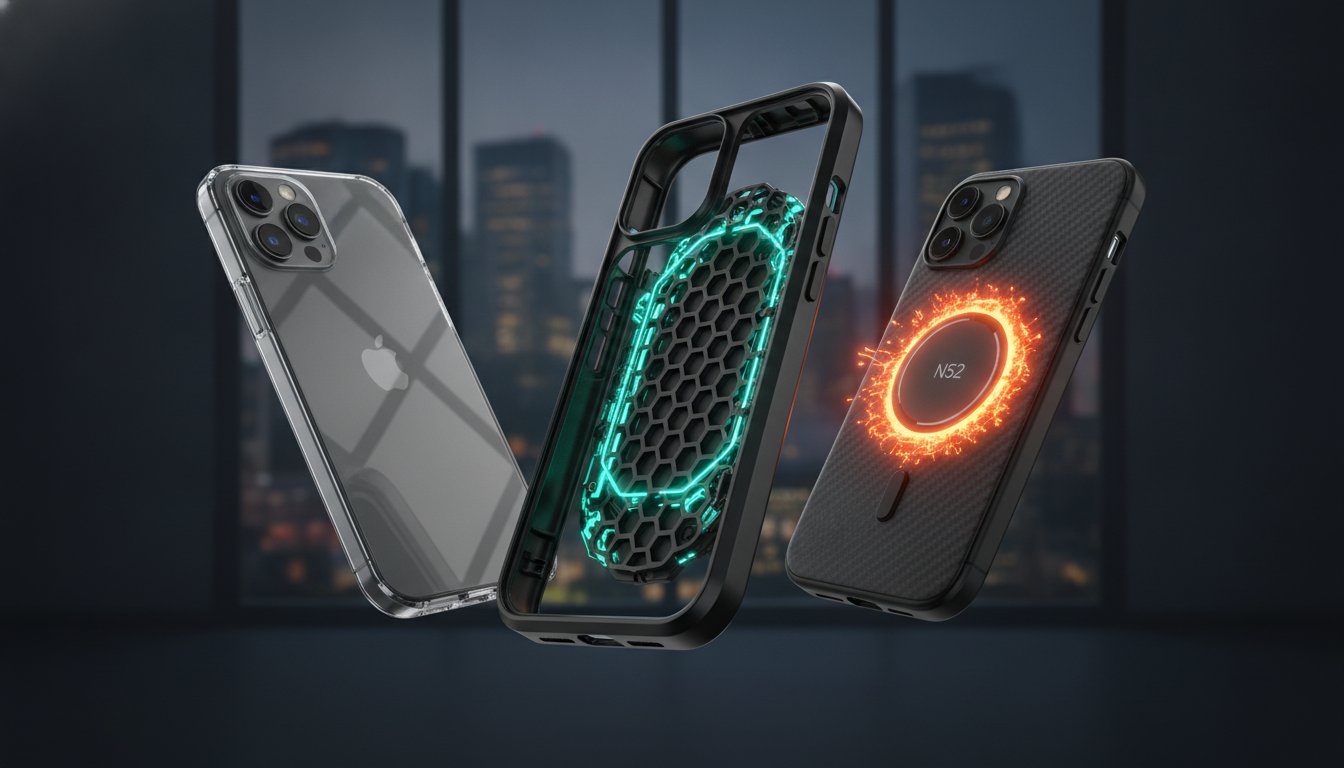
Did you know that roughly 68% of smartphone owners use a protective cover, yet nearly one billion plastic cases are sold globally each year due to frequent replacements? Most users realize that a standard iphone 16 case often fails to meet technical expectations for longevity or functionality. You likely want a solution that prevents screen cracks without adding unnecessary bulk to your pocket. It is common to worry about clear materials turning yellow or weak magnets causing accessories to slide off during a high-speed 25W charging session.
We've developed this guide to help you navigate the trade-offs between shock absorption and material density. You will learn how to identify cases that meet the MIL-STD-810G durability standard while maintaining a slim, ergonomic profile. Our analysis covers the performance of polycarbonate, which holds a 34% market share, and advanced Kevlar composites. The goal is simple. Maximum protection. Minimal bulk. Full Qi2.2 compatibility. We provide the technical data you need to make an informed purchase for your device.
Key Takeaways
- Evaluate the trade-offs between silicone, TPU, and polycarbonate to balance shock absorption with a slim, ergonomic profile.
- Learn why N52 neodymium magnets are essential in an iphone 16 case for reliable MagSafe connectivity and 25W charging speeds.
- Understand the technical reality of MIL-STD-810G ratings and how they translate to real-world drop protection on hard surfaces.
- Discover how the shift in the iPhone 16 chassis and camera layout impacts case selection and overall structural integrity.
- Recognize the material science behind long-term durability, focusing on anti-yellowing properties and professional-grade utility.
The Anatomy of iPhone 16 Protection: Why Design Matters
The iPhone 16 introduces several hardware updates that demand a specialized approach to protective design. With the transition to a vertical camera layout and the standardized inclusion of the Action Button, the structural requirements for an iphone 16 case have shifted. A case is no longer just a shell; it's a precision-engineered frame that must account for new pressure points and glass exposure areas. The shift in chassis design means that older accessories simply won't fit the refined dimensions of the latest generation.
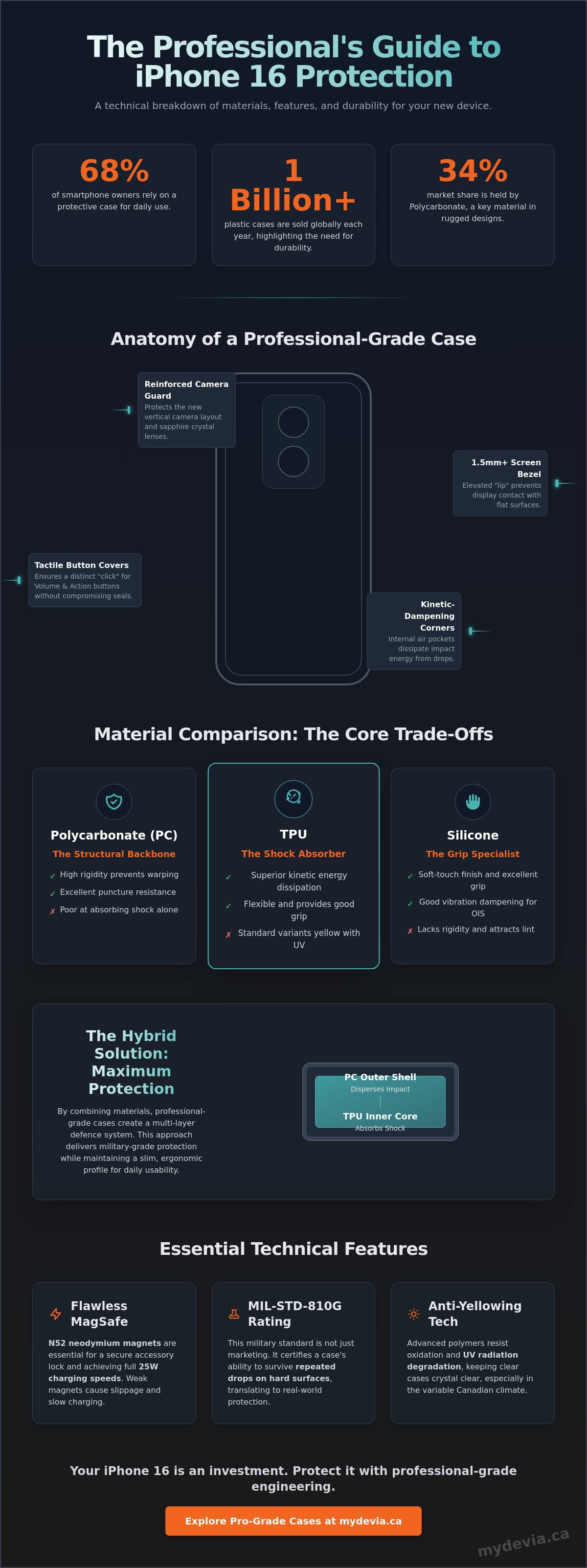
Corner reinforcement remains the most critical factor for surviving a drop. Modern smartphone glass is exceptionally durable against scratches, but the edges remain vulnerable to kinetic energy transfer. When a device hits concrete, the force concentrates at the point of impact. Professional-grade cases prioritize:
- Kinetic energy dissipation via internal air pockets.
- Dense TPU bumpers for edge-to-edge protection.
- Strategic material layering to prevent frame warping.
Structural Integrity and Bezel Height
The "lip" or bezel height is the first line of defence for the OLED display. A minimum elevation of 1.5mm is generally required to ensure the screen never touches a flat surface when placed face down. This prevents micro-abrasions that can weaken the glass over time. Similarly, the new vertical camera layout requires a raised ring to protect the lenses. Because the iPhone 16 supports spatial video capture, any scratch on the sapphire crystal can result in lens flare or focus issues. Precise cutouts are also mandatory. The transition to USB-C and the Action Button requires larger, more accessible openings that don't compromise the surrounding material strength.
Ergonomics vs. Protection
Choosing an iphone 16 case involves a technical trade-off between shock absorption and daily usability. A case that's too thick ruins the phone's ergonomics, making it difficult to use with one hand. Manufacturers now use dual-layer materials to keep profiles slim while maintaining impact resistance. Grip texture is another functional necessity. Smooth plastics often lead to drops, so look for laser-etched patterns or matte finishes that increase friction without attracting lint. Premium designs also prioritize button tactile feedback. You should feel a distinct "click" when pressing the volume or Action buttons, which is achieved through independent button covers rather than simple cutouts in the material. Lightweight composites ensure the device's centre of gravity remains balanced, preventing hand fatigue during extended use.
Material Comparison: Silicone, TPU, and Rugged Polycarbonate
Polycarbonate (PC) currently leads the protective market, accounting for approximately 34% of global sales in 2026. This rigid thermoplastic provides the structural backbone for many high-performance designs. However, a singular material rarely provides complete protection for a modern device. Silicone offers a soft-touch finish and superior grip, yet it lacks the structural rigidity required for high-velocity impacts. Thermoplastic Polyurethane (TPU) acts as the functional middle ground. It provides the elasticity and shock absorption that rigid plastics cannot match.
Hybrid designs are the industry standard for professional-grade protection. By layering these materials, manufacturers create a multi-defence system. The hard PC outer shell prevents punctures and disperses the initial force of a drop. Meanwhile, the inner TPU layer acts as a buffer. This combination ensures the iphone 16 case remains slim while meeting rigorous safety standards.
The Science of Shock Absorption
TPU is a semi-crystalline polymer engineered for elasticity. When your phone hits a hard surface, the TPU deforms at a molecular level. This physical reaction dissipates kinetic energy, spreading the force across the case rather than into the device's internal logic board. Silicone provides excellent vibration dampening. This is useful for protecting the optical image stabilization (OIS) in the new iPhone 16 camera modules. Rigid plastics like polycarbonate are excellent for structural integrity but do not dampen vibrations. This is why a hard shell over a soft core is the most effective configuration for real-world safety.
Long-term Durability and Aesthetics
A common pain point for users is the degradation of clear materials. Standard TPU cases often turn yellow after six months of use. This discolouration is caused by oxidation and exposure to UV radiation. In the Canadian climate, where UV levels can be high during summer months, material stability is vital. Premium cases use aliphatic TPU or UV-resistant coatings to prevent this chemical breakdown. Scratch resistance also varies significantly. Polycarbonate scores higher on the Mohs scale than silicone, making it better at resisting keys or coins in a pocket. If you want a balance of clarity and strength, you can explore technical iphone 16 cases designed for long-term aesthetic retention.
Functional Features: MagSafe Connectivity and Port Access
Modern connectivity requires more than just a hollow shell. For a high-performance iphone 16 case, functional utility is defined by its ability to integrate with an expanding ecosystem of magnetic and wired accessories. N52 neodymium magnets are the industrial benchmark for this integration. They provide the necessary pull force to prevent "charger walk," where thermal vibrations cause a device to shift off the induction coil. Without these high-grade magnets, heavy accessories like car mounts or battery packs will likely detach during standard vehicle movement or daily handling.
Thermal management is another critical technical consideration. The iPhone 16 series, specifically the Pro models, can now achieve up to 25W wireless charging speeds when paired with a compatible 30W adapter. This increased power delivery generates significant heat. A case that lacks proper thermal dissipation acts as an insulator, which triggers the device to throttle charging speeds to protect the battery. Professional designs utilize materials that allow heat to escape, ensuring that the device maintains peak performance during fast-charging cycles.
Optimizing the MagSafe Experience
Precision alignment is the difference between a fast charge and a failed connection. Built-in magnetic rings offer a significant advantage over "MagSafe compatible" thin cases that rely solely on the phone's internal magnets. These built-in rings bridge the gap created by the case material, maintaining a strong magnetic bond. To maintain peak 15W MagSafe charging efficiency, an iphone 16 case should ideally feature a backplate thickness of no more than 2.0mm. Anything thicker increases the distance between the coils, leading to energy loss and increased heat production.
Connectivity and Accessory Integration
Port clearance is a common failure point in rugged designs. Many high-performance USB-C cables and hubs have oversized housings that cannot seat properly in narrow case cutouts. This is particularly relevant for users who utilize a desktop setup. You can Explore our Leopard Series 11-in-1 Docking Station to see how professional-grade hubs require unobstructed access to the USB-C port for stable data transfer. Furthermore, the case must account for the device's acoustic hardware. Precise laser-cut openings for the microphone and speakers ensure that voice clarity and spatial audio output remain uncompromised by the protective layers. Modern cases must prioritize these technical tolerances to remain functional in a professional workspace.
Durability Standards: Decoding Drop Test Ratings for 2026
The label "military grade" is often used as a marketing catch-all, but it refers to a specific technical protocol known as MIL-STD-810G. For a smartphone, this typically involves the Transit Drop Test. This procedure requires the device to survive 26 drops from a height of 1.2 metres (4 feet) onto every face, edge, and corner. While this provides a baseline for structural integrity, it is important to realize that lab conditions rarely mirror the variables of a Canadian sidewalk. Lab tests often utilize plywood or steel surfaces, which lack the abrasive and unforgiving nature of concrete or asphalt.
To exceed these standards, an iphone 16 case must incorporate internal reinforcement. Look for air-cushion technology in the corners. These small pockets of air act as a crumple zone, compressing upon impact to slow the rate of deceleration. Internal ribbing along the backplate also adds rigidity, preventing the case from flexing and transferring energy directly to the device's glass back. You can browse high-impact iphone 16 cases that utilize these advanced geometric structures for superior protection.
Understanding MIL-STD-810G
The 26-drop protocol is a rigorous benchmark, but "passing" does not mean a device is indestructible. The standard allows for cosmetic damage as long as the phone remains functional. Another factor often overlooked is environmental temperature. In Canada, extreme cold can cause standard TPU and plastic to become brittle. A professional-grade case must maintain its molecular flexibility at sub-zero temperatures to ensure it doesn't crack when hitting the ground during a winter commute. Impact performance is a combination of material science and geometric engineering.
The Role of Screen Protection
A rugged case only covers five of the six sides of your device. The OLED display remains the most expensive component to replace, and it is highly susceptible to direct frontal impacts on uneven surfaces. Combining your case with a tempered glass screen protector is a mandatory secondary layer for full safety. Learn the basics of screen protection to understand how 9H hardness ratings prevent both scratches and catastrophic cracks. It is also vital to check for edge-to-edge compatibility. Some rugged cases feature high bezels that can lift the edges of a screen protector if the dimensions are not precisely aligned. Using a cohesive system ensures that the protective "lip" of the case and the glass shield work together without interference.
The Devia Approach: Professional Grade iPhone 16 Protection
Devia approaches device protection through the lens of material science and professional utility. We realize that an iphone 16 case is a functional tool, not just a decorative accessory. Our engineering focus remains on maintaining the structural integrity of your hardware while ensuring full access to its technical capabilities. By prioritizing high-density materials and precise manufacturing, we help users preserve the resale value of their devices. A phone kept in a professional-grade case for two years will consistently command a higher market price than one with micro-abrasions or frame warping.
Our commitment to quality involves strict adherence to functional standards. We don't rely on flashy marketing or bulk-buy discounts. Instead, we provide a curated inventory where every item is tested for connectivity, thermal management, and impact resistance. This disciplined approach ensures that your device remains a reliable asset in any workspace environment. We focus on the details that matter to power users, such as button responsiveness and material longevity.
Why Canadians Choose Devia
The Canadian market requires accessories that perform across diverse conditions. From the urban centres of Toronto to the colder climates of the prairies, material stability is a technical necessity. We provide a curated selection of high-performance tech accessories that prioritize hardware compatibility over aesthetic trends. This focus on technical specifications ensures that your iphone 16 case won't interfere with 25W MagSafe charging or high-speed data transfers via USB-C. You can compare these features with our Professional Guide to iPhone 17 Cases for future-proofing your next device upgrade.
Building Your Tech Ecosystem
Efficiency in the modern office depends on a seamless tech ecosystem. Your protective gear should integrate perfectly with your daily-carry items and desktop hardware. This means ensuring that magnetic mounts hold firm and that port cutouts accommodate professional docking stations without resistance. We also focus on aesthetic and functional continuity across your devices. Find the right Apple Watch bands to complete your setup and maintain a consistent professional appearance.
Devia supports this ecosystem with a systematic approach to logistics. We provide reliable shipping and professional support across Canada. Our goal is to act as a knowledgeable guide for consumers who value logical organization and technical reliability. We provide the components for a well-organized digital life, ensuring your hardware remains protected and productive.
Secure Your Device with Professional-Grade Gear
Selecting the right iphone 16 case requires a technical understanding of material density and connectivity standards. You now recognize that a hybrid construction of high-density TPU and polycarbonate provides the best defence against real-world impacts. Prioritizing N52 grade MagSafe magnets ensures your accessories remain secure during high-speed 25W charging sessions. Combining these structural elements with a tempered glass screen protector creates a complete safety system for your hardware.
Our curated inventory focuses on hardware compatibility and long-term durability. We prioritize products that meet rigorous durability benchmarks while maintaining the slim profile necessary for daily professional use. You can trust that our selection will integrate seamlessly with your existing tech ecosystem. It is the most efficient way to preserve your device's condition and maintain its resale value.
Shop Premium iPhone 16 Cases at Devia Canada for high-performance protection backed by national Canadian shipping. Protecting your investment doesn't mean sacrificing ergonomics or style. With the right technical specifications, you can maintain your phone's mint condition while enjoying full functional utility.
Frequently Asked Questions
Does an iPhone 16 case fit the iPhone 15 or iPhone 17?
No, an iphone 16 case is not cross-compatible with previous or future models. The iPhone 16 features a specific vertical camera arrangement and unique button placements, including the new Camera Control. Using a case designed for a different generation will result in misaligned cutouts and compromised structural integrity. Always verify the specific model generation before purchase to ensure a precise fit.
Will a thick rugged case prevent MagSafe charging from working?
Excessive thickness can interfere with wireless charging efficiency. If a case exceeds 2.0mm without integrated N52 magnets, the induction coils cannot maintain a stable connection. This leads to slower charging speeds and increased thermal output. For peak 25W performance, always select a case with a built-in magnetic ring to bridge the gap between the charger and the device.
How do I prevent my clear iPhone 16 case from turning yellow?
To prevent yellowing, select cases manufactured with aliphatic TPU or those featuring specialized anti-oxidation coatings. Discolouration is primarily caused by UV radiation and chemical reactions with skin oils. Regular cleaning with mild soap and avoiding prolonged exposure to direct sunlight will help maintain the material's clarity. Higher-quality polymers are engineered to resist this chemical breakdown for longer periods.
Is a screen protector necessary if I have a case with a raised bezel?
A screen protector is essential for comprehensive safety. While a raised bezel protects the display on flat surfaces, it cannot prevent damage from direct impacts on uneven ground or sharp objects. A tempered glass shield acts as a sacrificial layer that absorbs frontal force. This prevents costly OLED repairs and keeps the original glass surface free from micro-scratches.
What is the best material for drop protection: silicone or TPU?
TPU is the superior material for impact resistance. As a semi-crystalline polymer, it possesses the elasticity required to dissipate kinetic energy during a drop. Silicone provides excellent grip and soft-touch aesthetics, but it lacks the structural density needed to protect internal hardware from high-velocity shocks. Most professional-grade cases use a TPU bumper for this specific technical advantage.
Do Devia cases allow for large third-party USB-C charging cables?
Yes, Devia cases are designed with generous port clearance. We recognize that professional users often utilize oversized USB-C cables or multi-port docking stations for data transfer. Our cutouts are laser-cut to ensure a secure fit for third-party accessories without requiring the removal of the iphone 16 case. This maintains functional utility in a desk-based workspace.
How often should I replace my phone case to ensure maximum protection?
We recommend replacing your case every 12 months or immediately after a severe impact. Protective materials like polycarbonate and TPU experience microscopic fatigue and UV degradation over time. This causes the polymers to become brittle and less effective at absorbing shock. Periodic replacement ensures that the protection levels remain within their original technical specifications.
Can I use a MagSafe wallet with a non-MagSafe iPhone 16 case?
You cannot securely use a MagSafe wallet with a standard, non-magnetic case. The case material acts as a barrier that significantly weakens the magnetic pull from the phone's internal coils. Without a dedicated N52 magnetic ring built into the case backplate, accessories will likely slide off during normal handling. A MagSafe-integrated case is mandatory for secure accessory attachment.